
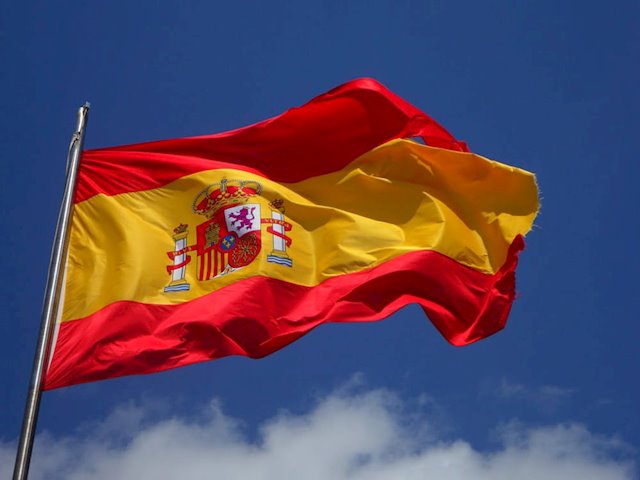
Spain is a European country located in Southwestern Europe with some pockets Spanish territory across the Strait of Gibraltar and the Atlantic Ocean
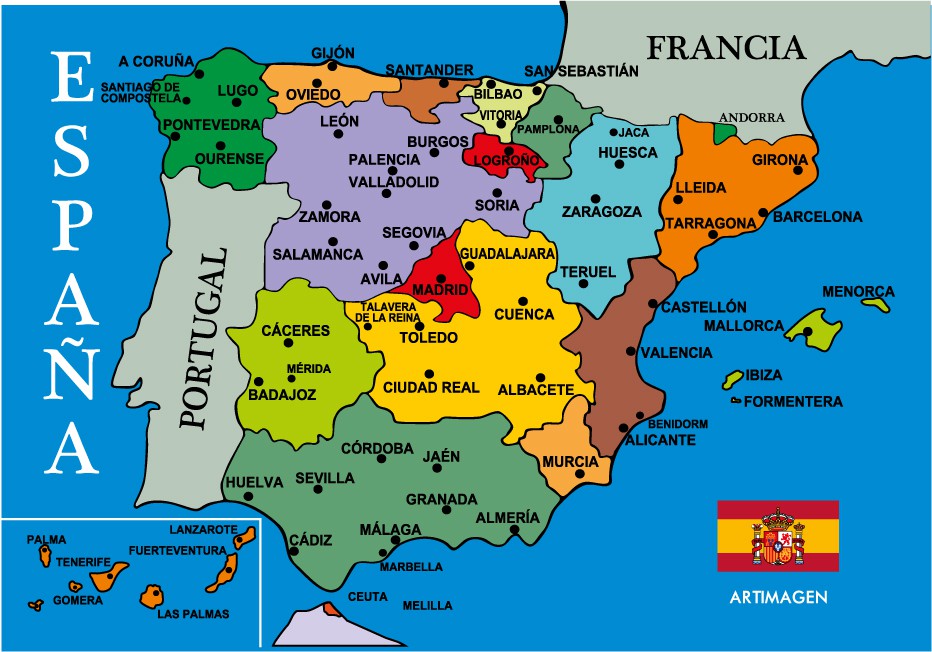
Its continental European territory is situated on the Iberian Peninsula. Its territory also includes two archipelagoes: the Canary Islands off the coast of Africa, and the Balearic Islands in the Mediterranean Sea.
The African enclaves of Ceuta, Melilla, and Peñón de Vélez de la Gomera make Spain the only European country to have a physical border with an African country (Morocco).Several small islands in the Alboran Sea are also part of Spanish territory. The country’s mainland is bordered to the south and east by the Mediterranean Sea except for a small land boundary with Gibraltar; to the north and northeast by France, Andorra, and the Bay of Biscay; and to the west and northwest by Portugal and the Atlantic Ocean.
POPULATION
It has an extension of 505 370 km², the administrative power of Western Sahara is Spain and by which an area of 772 000 km² is determined.
It is the fourth largest country on the continent, after Russia, Ukraine and France.
With an average altitude of 650 meters above sea level it is one of the most mountainous countries in Europe.
Its population is 47 100 000 inhabitants (2020), which by resolution amounts to approximately 47 649 000 inhabitants.
The peninsular territory shares land borders with France and Andorra to the north, with Portugal to the west and with the British territory of Gibraltar to the south.
In its African territories, it shares land and sea borders with Morocco.
He shares with France the sovereignty over the island of the Faisanes at the mouth of the Bidasoa River and five Pyrenean facerías.
PLACE TO VISIT
–ALCAZAR OF TOLEDO:Located on a hill, it is the most representative monument of the city of Toledo. It was ordered to be built in 1545 by Emperor Carlos V to have a residence worthy of such a monarch. In 1936 he was occupied by the rebel Colonel Moscardó in command of the Civil Guard, resisting 70 days until his release. It currently houses the Castilla la Mancha library and is one of the most important monuments in Spain.
–THE ROYAL PALACE:The Royal Palace of Madrid is one of the 20 most beautiful palaces in the world, as well as one of the 10 most important monuments in Spain. Its construction began in 1738 and the works lasted for 17 years. With an area of 135,000 m² and 3,418 rooms, it is the largest Royal Palace in all of Western Europe. It houses a valuable historical-artistic heritage.
–WALL OF AVILA:The Romanesque wall of Ávila is one of the most important monuments in Spain. The old town, the wall and the churches located outside the walls have been declared a World Heritage Site. It is the best preserved medieval walled enclosure in Spain and probably in all of Europe.
–AQUEDUCT OF SEGOVIA :The Aqueduct of Segovia is a Roman aqueduct that dates back to the beginning of the second century AD, the time of Emperor Trajan. It is one of the most important monuments in Spain. Built with granite ashlars, it covers more than 15 kilometers, the route can be done on foot starting from the swamp of Puente Alta.
-MOSQUE OF CORDOBA: The Mosque of Cordoba, is one of the most important monuments of Islamic architecture in Spain, as well as the most emblematic example of Spanish-Muslim Umayyad art. Its construction began in 785, it is declared Cultural Heritage of Humanity as part of the historic center of the city.
TYPICAL FOOD
–THE POTATO OMELETTE: It is said that the first known document that refers exactly to potato tortillas comes from 1817, and is of Navarre origin. However, long before, the Indian chronicles document that around 1519 the egg tortilla was already known in America and in Europe. Be that as it may, the truth is that it is currently one of the dishes that all Spaniards carry in their genes and can be tasted in any of the cities of the country, from Seville to Barcelona or La Coruña. It is known, for example, the “defragmented” version of this recipe launched by the internationally renowned chef: Ferrán Adrià.
–GAZPACHO:It is unimaginable to spend a summer and its high temperatures in southern Spain without the help of a good cold gazpacho. This recipe whose main ingredients are tomato, cucumber, onion, olive oil, garlic and some bread, is indispensable on the days of more intense heat and can be described as a cold soup. It usually comes with small pieces of fried bread, cucumber or red pepper. In Andalusia there is also a similar recipe known as Salmorejo, more consistent than gazpacho, but just as tasty. Traditionally, the origin of gazpacho has always been assimilated to Andalusia, although it is not known exactly where it comes from, but it is one of the most traditional dishes and you can find it throughout Spain.
–PAELLA:The word paella originally designated the pan, and, despite its many variations there is an ingredient that is always present: rice. It is said that the traditional Valencian paella was a mixture of rice with those foods that the farmers had on hand: chicken, rabbit and vegetables typical of Valencia such as the garrofón or the tabella. But over the years, the recipe was evolving and it is usual to find mixed with the rice, in addition to the mountain elements, typical complements of the sea (such as sepia or prawns).
 holidays blog